




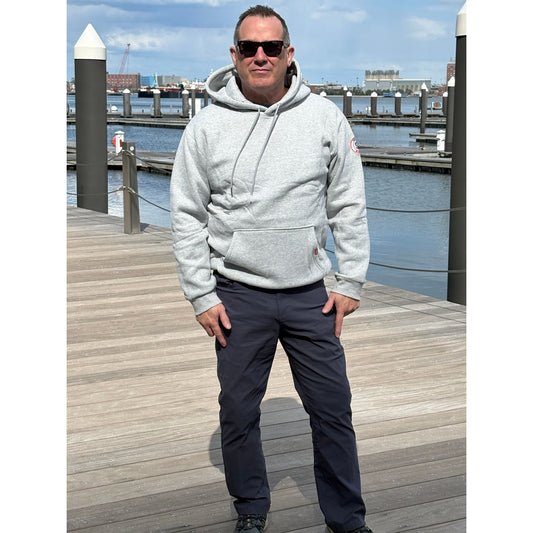


There's a reflex most people have when they think about dressing for cold weather near the water: reach for a jacket. It makes sense on paper. But spend a few seasons actually living and working around Boston Harbor and you start to see the flaw in that logic.
Jackets are designed for sustained cold. The Seaport isn't sustained cold — it's variable cold. Wind off the water, then a warm patch of sun, then a fog bank, then nothing. A jacket that's right for one moment is wrong for the next. You're constantly taking it on and off, carrying it, leaving it somewhere.
A heavyweight sweatshirt solves this differently. Here's the full case.
The conditions argument
Boston Harbor creates a specific kind of cold. It's not the dry, still cold of an inland winter day — it's damp, moving cold that comes at you from different directions depending on where you're standing and what the wind is doing. The Fort Point Channel funnels wind from the south. The open harbor sends it from the east. On bad days, you feel both.
The Seaport's peninsula geography makes this worse than most waterfront neighborhoods. There's no buffer — the wind finds you wherever you are. For more on how the neighborhood's geography shapes the experience of being there, see A Local's Guide to the Boston Seaport District and the History of The Seaport District in Boston.
The construction argument
A quality heavyweight cotton sweatshirt insulates through the fabric itself — dense loops of cotton that trap air and hold heat without relying on fill materials that compress when wet or shells that lose breathability under exertion. It breathes when you're moving. It holds heat when you stop.
Our Black SuperHeavy Hoodie and Elements Gray Hoodie are built on this principle — heavyweight cotton construction that performs on the waterfront without performing for the waterfront. The Elements Black Hoodie and Elements Blue Hoodie follow the same logic at a slightly different weight — the right call for the 45–55 degree range that covers most of fall and spring on the harbor.
The versatility argument
A jacket signals “I'm going outside.” A heavyweight sweatshirt goes everywhere without changing the register of what you're wearing — the HarborWalk, the office, lunch at Row 34, a meeting at the ICA, dinner somewhere with an implicit dress code.
The Navy Blue Crewneck Sweatshirt is the clearest example of this. The Gray Crewneck Sweatshirt is the more neutral version of the same idea. For a full season-by-season breakdown of how these pieces work across the year, see What to Wear in Boston's Seaport District Year-Round.
The durability argument
Good jackets are expensive and, in many cases, delicate. Technical fabrics delaminate. Zippers fail. Fill materials clump after washing.
A well-made heavyweight sweatshirt gets better with wear. The cotton softens and settles. The fit relaxes in the right places. The color develops character rather than fading into nothing. It's the kind of garment that earns its place in your rotation rather than sitting in a closet. For more on the construction philosophy behind Seaport Brand, read Born in Boston Harbor.
The practical conclusion
For the 200-plus days a year when the Seaport is in that variable, harbor-cold range, a heavyweight sweatshirt is the more useful, more versatile, and more durable answer. The people who figure this out stop reaching for their jacket first. For more on what that looks like in practice, read What Locals in the Seaport District Actually Wear.
Shop Heavyweight Sweatshirts →
Read next
- What to Wear in Boston's Seaport District Year-Round
- The Seaport District Uniform: Why Boston Runs on Heavyweight Hoodies
- What Locals in Boston's Seaport District Actually Wear
- Born in Boston Harbor: The Story Behind Seaport Brand
- Why Seaport Hoodies Are So Popular in New York and Boston
- Seaport Boston: Where Waterfront Living Meets Everyday Style